

AI campaigns that work started with a human idea
AI makes it possible to publish everywhere, fast. The campaigns that actually landed all had the same thing steering that speed: a real human idea.
Of newly published web pages already include AI-generated content, scale is now the baseline (Ahrefs, 2025)
Correlation between how much AI a page uses and its Google ranking, essentially zero either way (Ahrefs, 2025)
Projected drop in traditional search volume by 2026, pushing brands to show up in more places, more often (Gartner, 2024)
Scale is no longer optional. It's also no longer the differentiator
Producing content at the pace today's channels require used to mean a bigger team than most companies could justify. Generative AI removed that need: a first draft, a dozen format variants, a translated version, all within the time it used to take to brief a single piece. An Ahrefs analysis of 900,000 newly created web pages shows that 74.2% contain some AI-generated content, though only 2.5% are written by AI with no human editing at all (Ahrefs, 2025). Producing more, faster, across more channels, is one of the real uses of AI, and exactly what most brands need today to keep up with what a modern content calendar requires.
The trade-off is that any competitor has access to the same tool, which means scale on its own stops being what sets a brand apart. Ahrefs analysed 600,000 pages and found a correlation of 0.011 between how much AI a page uses and its position on Google, essentially no relationship in either direction (Ahrefs, 2025). Using AI to produce more doesn't hurt, but it doesn't help either without a thought-out strategy behind it.
The audience isn't waiting in one place anymore
Gartner projected in 2024 that traditional search engine volume would drop 25% by 2026, as AI chatbots and virtual agents absorb queries that used to land on a search results page (Gartner, 2024). Pew Research Center's tracking of real browsing behaviour shows the same shift from the reader's side: when a Google search produces an AI summary, users click through to a traditional result in just 8% of visits, against 15% when no summary appears (Pew Research Center, 2025). None of this is an argument for producing less. It's precisely the opposite: it's an argument that proves the need to show up in more places, with more consistency, because user attention is spreading across more channels than a single search results page ever held. This is exactly the context AI-driven scale was built for, as long as there is a thought-out strategy and concept behind it.
The campaigns that prove it, and the ones that don't
The need for production at scale is real, and AI is one of the realistic ways to reach more assets, more variants, content in different languages, formats that go beyond what teams could produce by hand. Looking at any well-structured AI campaign, none of them started with the tool, they started with a specific creative idea, decided by people, that AI then executed and scaled.
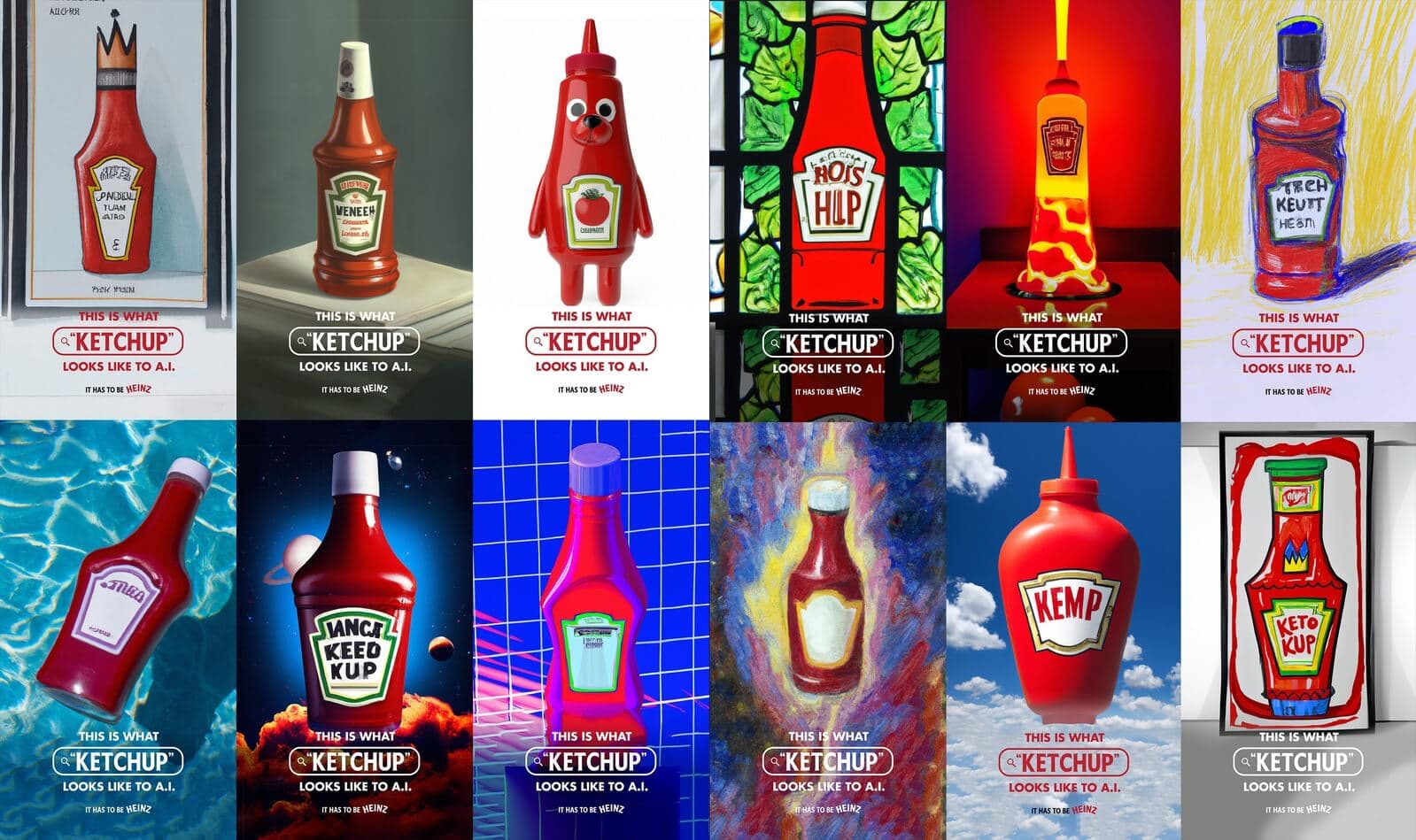
Heinz's “A.I. Ketchup” is a clear example. The creative idea, from agency Rethink Toronto, was human and simple: feed DALL-E 2 unbranded prompts like “ketchup,” and see what the model drew, betting that Heinz's bottle was so present in culture that AI would draw it without being told to. That bet, not the tool, is what made the campaign work. AI generated the images; the idea that made them worth generating, and the decision to build a global campaign, an art gallery, and limited-edition bottles around the result, was entirely human. It won a Drum Award and a One Show Pencil, and generated over 850 million earned media impressions worldwide, with an engagement rate 38% higher than Heinz's previous campaigns, worth more than 25 times the media investment (The One Club, 2023).
Coca-Cola's “Create Real Magic,” developed with OpenAI and Bain & Company, is the same pattern on a bigger scale. The company has been explicit that every key creative decision behind its AI-generated advertising, whether the brief, narrative, emotional arc, or music, is made by human creative teams, with AI used only to execute and scale those decisions, not to create them (The Coca-Cola Company, 2023). Thirty selected artists were flown to Atlanta for a creative academy specifically so that a person, not a prompt, would decide what the platform's output should look like before it reached the public.

Neither campaign proves that scale is risky. They prove where the value of scale actually comes from: not from having AI, everyone has that today, but from having something that's genuinely worth scaling.
The part worth paying attention to is what happens when scale moves ahead without that. Throughout 2025, J.Crew, Shein, and Skechers were all publicly criticised for AI-generated ads that reached the public with visible problems: a foot bent the wrong way and distorted props in an Instagram campaign, a t-shirt graphic that resembled a real defendant from a criminal case, a generic, poorly rendered figure on a billboard (eMarketer, 2025). None of these brands hid their use of AI, the flaws were visible in the ad that had already been published. The tool wasn't the failure in any of these cases. What was missing was review by human creative teams with a clear idea of what the piece needed to do, and of the result, before it went live.
The question shouldn't be whether or not to produce content at scale with AI, but who is driving that scale and which idea they're producing it for. Heinz and Coca-Cola defined a strong creative idea offline and used AI to execute it everywhere at the same time. J.Crew, Shein, and Skechers let the tool run without that layer and without human aesthetic review, and it quickly became obvious to the public. All of this with the same technology, the same access to scale, but with the opposite result.
How to scale content without losing what makes it work
None of this is an argument against producing more. It's an argument for building the one step that makes producing more actually worth it. A practical way to structure a content operation around AI-driven scale:
1. Start with a human idea, not a prompt. Decide the angle, argument, or storytelling before using any AI tool. Trying to sum up the idea in one sentence without mentioning AI is a necessary exercise for defining a well-structured idea.
2. Let AI scale it, not make the initial decision. Once the idea is defined, AI is the means to bring it to life across formats, languages, and variants without diluting that idea. The idea, the brand voice, and the final call always stay with the creative team.
3. Connect everything back to the brand, with a clear purpose. A proprietary data point, a client result, a tone of voice specific to the brand. If a competitor's AI could produce the same piece just by swapping the name, that could mean the idea wasn't original, with or without AI.
4. Review before publishing. Check the result against the idea before it goes live, making sure the content is actually ready to publish.
5. Measure what the idea produced, not just how much was produced. Time on page, scroll depth, assisted conversions, whatever ties back to revenue. A scaled operation pays off when the result actually performs.
The bottom line
Scale was never the risk. The AI campaigns that worked prove that publishing more, faster, across more channels, is exactly what today's marketing requires, and one of the best uses of AI. What separates the campaigns people remember from the ones brands would rather forget was never how much they produced, but the idea behind them, and whether there was a team standing behind it defending it.
Sources
- Ahrefs (2025). “74% of New Webpages Include AI Content (Study of 900k Pages).” https://ahrefs.com/blog/what-percentage-of-new-content-is-ai-generated
- Ahrefs (2025). “AI-Generated Content Does Not Hurt Your Google Rankings.” https://www.ahrefs.com/blog/ai-generated-content-does-not-hurt-your-google-rankings
- Gartner (2024). “Gartner Predicts Search Engine Volume Will Drop 25% by 2026, Due to AI Chatbots and Other Virtual Agents.” https://www.gartner.com/en/newsroom/press-releases/2024-02-19-gartner-predicts-search-engine-volume-will-drop-25-percent-by-2026-due-to-ai-chatbots-and-other-virtual-agents
- Pew Research Center (2025). “Google Users Are Less Likely to Click on Links When an AI Summary Appears in the Results.” https://www.pewresearch.org/short-reads/2025/07/22/google-users-are-less-likely-to-click-on-links-when-an-ai-summary-appears-in-the-results/
- The One Club (2023). “Kraft Heinz: A.I. Ketchup.” https://www.oneclub.org/awards/theoneshow/-award/48666/ai-ketchup/
- The Coca-Cola Company (2023). “Coca-Cola Invites Digital Artists to ‘Create Real Magic’ Using New AI Platform.” https://www.coca-colacompany.com/media-center/coca-cola-invites-digital-artists-to-create-real-magic-using-new-ai-platform
- EMARKETER (2025). “J.Crew, Shein, Skechers Slammed for Flawed AI Ad Campaigns.” https://www.emarketer.com/content/j-crew--shein--skechers-slammed-flawed-ai-ad-campaigns
Author

Yetiman Team
Editorial Team
Yetiman Team creates content focused on practical AI implementation, covering strategy, automation, adoption, marketing systems, copilots, and applied business use cases.