What Are AI Chatbot Integrations? Types, Examples, and How They Work
What Are AI Chatbot Integrations? Types, Examples, and How They Work
AI chatbot integrations connect chatbots to the systems that run the business. From CRM and helpdesk to scheduling, messaging, ecommerce, and APIs, they turn chatbots into operational tools rather than simple assistants.
AI chatbots are becoming an important part of modern business operations, helping companies automate support, generate leads, and improve workflows. But their real value does not come from conversation alone. It comes from how well they integrate with the systems that already run the business.
Most chatbot failures are not caused by AI quality alone. They happen when the chatbot is disconnected from the tools teams actually use. Once connected to CRM, helpdesk, knowledge bases, scheduling systems, messaging channels, ecommerce platforms, and APIs, chatbots become operational systems rather than simple assistants.
What Are AI Chatbot Integrations?
AI chatbot integrations connect chatbots to business systems so they can take actions, not just answer questions.
They turn a chatbot into a tool that can update data, trigger workflows, and interact with real systems.
With integrations, chatbots can:
Create CRM leads
Generate support tickets
Access documentation
Schedule meetings
Track orders
Without integrations, they remain limited to generic responses.
Why AI Chatbot Integrations Matter
Integrations remove friction between user intent and business execution.
Instead of manual steps across different tools, users complete actions inside the conversation.
The impact is often significant: faster responses, fewer manual tasks, and better conversion rates.
Best AI Chatbot Integrations
Type | Benefit | Examples |
|---|---|---|
CRM | Lead generation | HubSpot, Salesforce |
Helpdesk | Support automation | Zendesk, Intercom |
Knowledge Base | Accurate answers | Notion, Confluence |
Scheduling | More bookings | Calendly, Google Calendar |
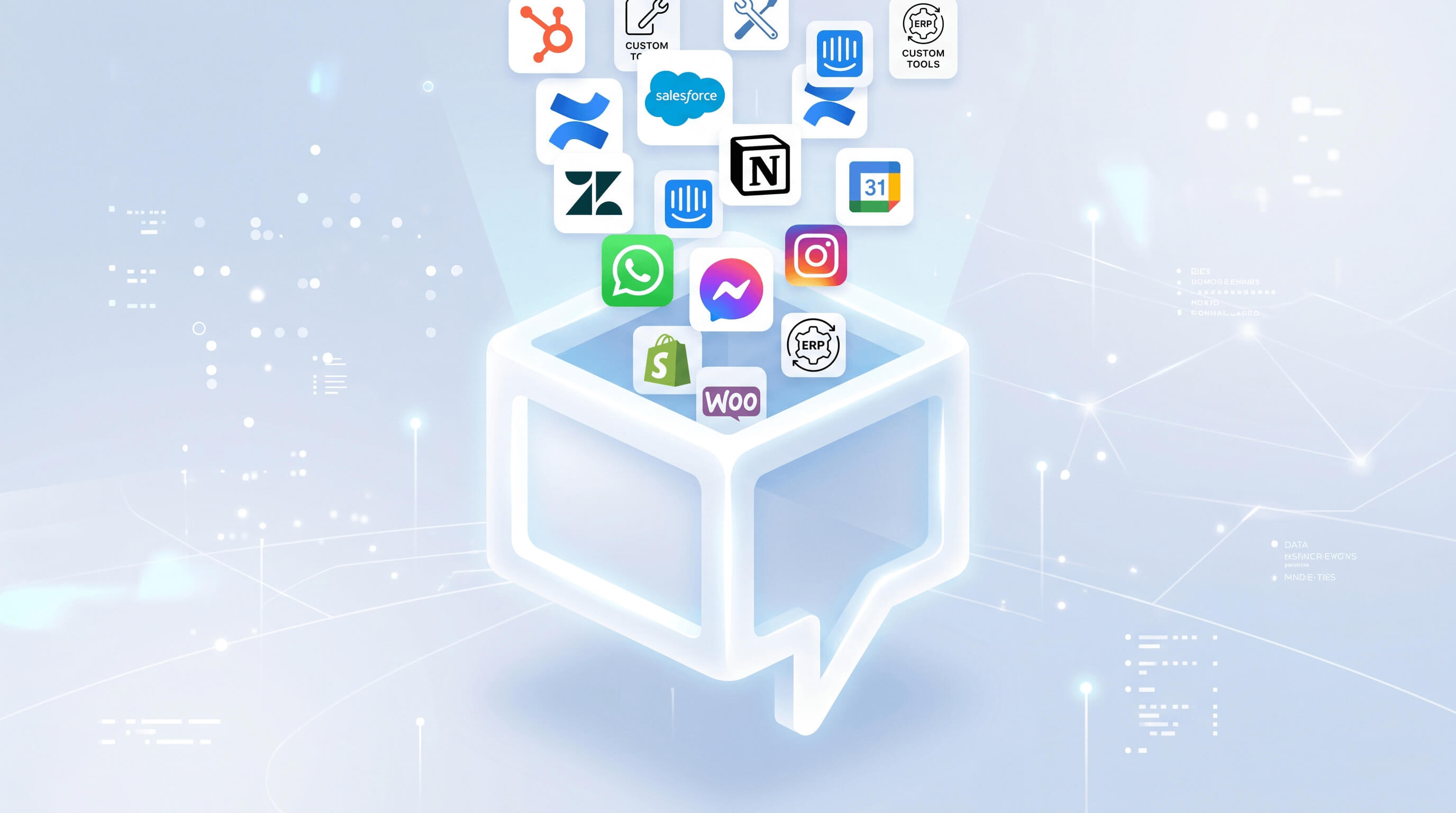
Messaging | Customer engagement | WhatsApp, Messenger, Instagram DM |
Ecommerce | Order support | Shopify, WooCommerce |
API | Full automation | ERP systems, custom tools |
Which Integration Should You Start With?
Goal | Best Integration |
|---|---|
Leads generation | CRM |
Support reduction | Helpdesk |
Self-service | Knowledge Base |
Bookings | Scheduling |
Ecommerce support | Ecommerce |
Automation | API |
CRM and helpdesk usually often deliver the fastest ROI.
CRM Integrations
CRM integrations connect chatbots directly to sales systems such as HubSpot or Salesforce. This allows the chatbot to qualify leads, create contacts automatically, and pass the right information to the sales team without delay. The result is faster follow-up and a smoother path from interest to conversion.
Helpdesk Integrations
Helpdesk integrations automate common support requests.
A chatbot connected to Zendesk or Intercom can handle tracking, billing, and basic troubleshooting instantly.
When needed, it creates a ticket with full context for human agents.
Messaging Integrations
Messaging integrations bring chatbots into channels users already use, such as WhatsApp, Messenger, or Instagram. This makes interactions faster and more natural, whether the goal is support, order updates, or lead handling. In many cases, it also improves response rates by keeping the conversation in familiar channels.Knowledge Base Integrations
Knowledge base integrations ensure answers come from trusted documentation.
By connecting to Notion or Confluence, chatbots provide consistent and accurate responses.
Scheduling Integrations
Scheduling integrations remove friction from booking meetings.
A chatbot connected to Google Calendar or Calendly can check availability and schedule meetings instantly.
Ecommerce Integrations
Ecommerce integrations improve customer experience and sales.
Chatbots can handle order tracking, product questions, and recommendations in real time.
API Integrations
API integrations connect chatbots to internal systems like ERP or databases.
This enables advanced automation such as real-time inventory or workflow triggers.
Best Practices
Focus on high-impact integrations first (CRM, support, messaging).
Maintain clean data and secure access, since integration quality depends on system reliability.
Conclusion
AI chatbot integrations are what turn conversational tools into operational systems. By connecting chatbots to CRM, helpdesk, knowledge bases, scheduling platforms, messaging channels, ecommerce systems, and APIs, businesses can automate real workflows instead of limiting chatbots to generic interactions.
The result is not just better automation. It is faster execution, stronger efficiency, and a chatbot that becomes part of how the business actually works.
FAQs
What integrations should an AI chatbot have?
The most useful starting integrations are usually CRM, helpdesk, knowledge base, scheduling, and messaging.The right priority depends on the business goal.
Can chatbots use WhatsApp or Messenger?
Yes, both are widely supported messaging channels.
Are integrations secure?
They can be, as long as authentication, permissions, and access rules are implemented properly.
How long does setup take?
Simple integrations can take days. More complex or enterprise-level systems may take weeks, especially when internal tools or APIs are involved.
Author

Filipe Oliveira
Full Stack Developer
Full Stack Developer passionate about turning ideas into living digital experiences. I work at the intersection of code, 2D/3D animation, and UX to create interfaces that don’t just function — they engage.